
Emergency storm roof repair San Antonio is a service that Bexar County homeowners need more frequently than almost anywhere else in Texas, yet most are completely unprepared for the moment it becomes necessary. San Antonio sits at the crossroads of three distinct storm systems: Gulf moisture pushing north from the coast, dry line thunderstorms firing along the Interstate 35 corridor, and cold fronts sweeping down from the Panhandle that collide with warm air to produce violent hail and straight-line wind events with very little advance warning.
When one of these systems damages a roof, the decisions made in the first two hours determine whether the outcome costs hundreds of dollars or tens of thousands. This guide covers the storm-specific damage patterns San Antonio homeowners face, how to respond correctly to each one, and how to protect both the home and the insurance claim from the moment the storm passes.
What is Emergency Storm Roof Repair San Antonio? (The Simple Definition)
Emergency storm roof repair San Antonio is an immediate, storm-triggered roofing service that stabilizes a roof damaged by hail, high wind, lightning, flooding, or wind-driven rain to prevent further water intrusion, structural deterioration, and interior damage while a permanent repair is planned and scheduled. The emergency repair is not a finished product. It is a protective bridge between the storm event and the permanent solution.
What separates emergency storm roof repair from routine repair is the time pressure involved. Water entering through a storm-damaged roof does not wait for a convenient appointment window. Every additional storm, even a moderate rain event, that passes through an unprotected breach in the roof system adds damage to the deck, insulation, framing, and interior finishes below.
San Antonio Storm Types and Roof Damage Patterns
| Storm Type | Peak Season | Primary Roof Damage | Emergency Action |
|---|---|---|---|
| Hail storm | March through June | Granule loss, bruised and cracked shingles, and dented metal | Inspection, documentation, tarping if deck is exposed |
| Straight-line wind | April through September | Shingle blow-off, ridge cap loss, lifted flashing | Emergency tarping and fastener resecurement |
| Supercell thunderstorm | April through July | Combined hail and wind damage, antenna and equipment displacement | Full perimeter inspection and tarping |
| Tropical moisture event | June through November | Sustained rain infiltration at flashing points, saturated insulation | Flashing emergency seal, attic moisture mitigation |
| Winter ice storm | December through February | Ice dam formation, freeze-thaw flashing failure, gutter damage | Ice removal, temporary flashing seal |
| Microburst wind event | May through August | Localized catastrophic blow-off, structural frame damage | Structural assessment before any repair work |
San Antonio’s storm calendar runs nearly year-round, with meaningful roof damage risk present in every month. Understanding which storm type caused the damage guides the correct emergency response and avoids wasted effort addressing the wrong failure mode.
Why Emergency Storm Roof Repair in San Antonio Matters (The Real Cost Breakdown)
What Delayed Action Costs San Antonio Homeowners
| Delay Scenario | Cost of Inaction | Cost of Immediate Emergency Repair |
|---|---|---|
| Exposed deck through one additional rain event | $3,000 to $8,000 additional deck and insulation damage | $250 to $600 emergency tarp |
| Unsecured blown-off panel becomes a projectile | $1,500 to $10,000 vehicle or property damage | $300 to $800 panel resecurement |
| Flashing gap through a tropical rain event | $4,000 to $15,000 interior wall and ceiling damage | $200 to $500 temporary flashing seal |
| Saturated insulation not dried within 48 hours | $3,000 to $10,000 mold remediation | $500 to $1,500 moisture mitigation service |
| Damage undocumented past Texas claim filing window | $8,000 to $20,000 unpaid insurance claim | Free inspection and photo documentation |
San Antonio homeowners who respond to storm roof damage within the first two to four hours consistently achieve better physical outcomes and stronger insurance claim settlements than those who wait for a scheduled appointment. The emergency stabilization cost is almost always recoverable through the insurance claim. The escalated damage from a delayed response is not.
The San Antonio Insurance Claim Window
Texas law provides homeowners one year from the date of a qualifying storm event to file a wind and hail insurance claim. In San Antonio, where multiple qualifying events can occur within the same season, homeowners who do not document damage promptly risk conflating multiple storm events into a single claim or missing the filing window on the first event entirely. An emergency response that includes date-stamped photo documentation from the day of the storm creates a clear record that protects the full claim value.
Types of Emergency Storm Roof Damage in San Antonio: Know What You Are Dealing With
San Antonio storm damage presents in patterns that reflect the specific storm type that caused it, and correctly identifying the damage pattern determines the appropriate emergency repair approach. Hail impact damage ranges from barely visible granule displacement on a mild event to through-cracked shingles and exposed fiberglass mat on a severe one. The most important distinction in hail damage assessment is whether the impact has penetrated through the shingle surface to expose the deck below.
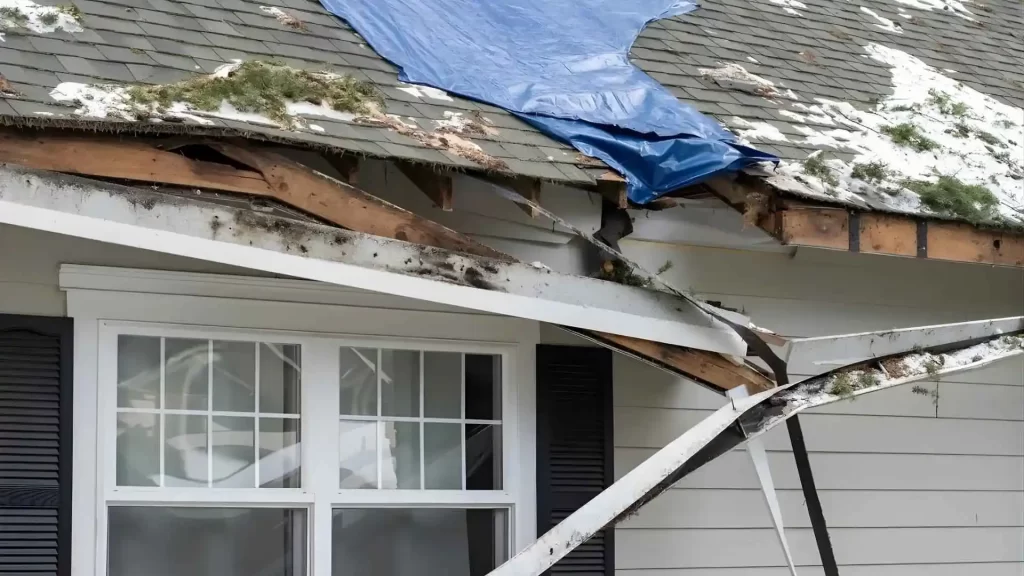
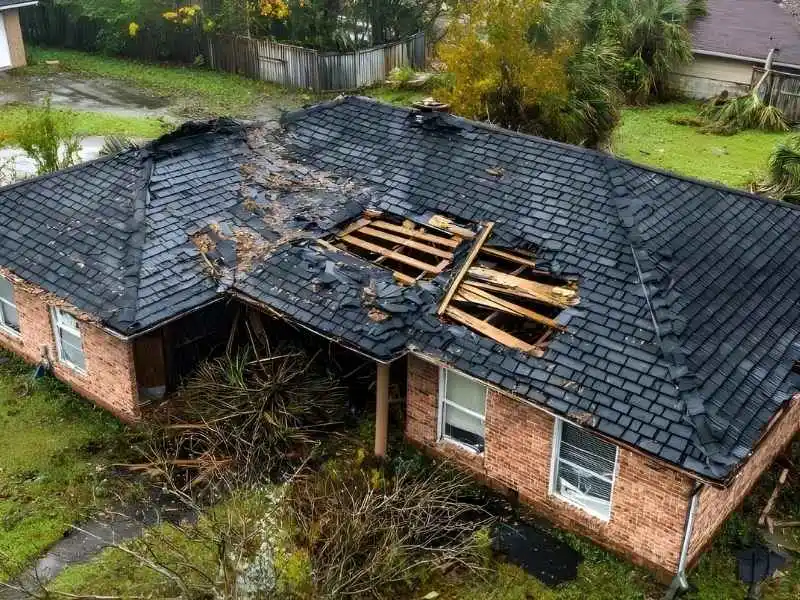
Surface hail damage without deck exposure is a documentation and claim priority. Through-damage with deck exposure is an emergency tarping priority. Wind shingle blow-off creates zones of complete deck exposure where shingles have lifted from their sealant strips and been carried off the roof entirely. Blow-off patterns on local roofs typically begin at ridge caps and eave edges, the highest wind pressure zones, before progressing into the field if wind loading continues.
Any blow-off exposing more than four to five square feet of deck requires immediate emergency storm roof repair San Antonio homeowners can rely on, specifically same-day tarping to prevent water entry during the next rain event. Combined hail and wind damage from area supercell thunderstorms creates the most complex scenarios because the two damage types interact; wind loosens fasteners and sealant adhesion while hail simultaneously impacts weakened asphalt shingles on the roof.
This produces damage more extensive than either force would create alone, requiring professional tarping and a detailed damage scope before permanent repairs begin. Flashing failure from tropical moisture events develops differently from impact damage. Sustained wind-driven rain at the volumes produced by tropical systems finds every small gap in the flashing system at chimneys, vents, skylights, and valleys, and forces water through openings that would be inconsequential in a standard rain event.
Emergency response to tropical moisture flashing failure involves identifying and temporarily sealing every infiltration point before the next band of rain arrives, rather than waiting for a comprehensive permanent repair window.
Ice storm roof damage in San Antonio, while less frequent than warm-season storm damage, presents specific emergency challenges because ice removal from a damaged roof must be managed carefully to avoid adding impact damage to the storm-damaged surface during extraction.
Emergency Storm Roof Repair in San Antonio: Step-by-Step Response
The first two hours after a San Antonio storm event are the most consequential window in the entire repair process. Every step in the correct sequence matters.
Step 1: Wait for the storm to fully pass before any exterior assessment. Do not go onto or near the roof during an active storm or immediately after a lightning-producing event. Confirm that the weather has fully cleared before beginning any exterior inspection or documentation.
Step 2: Assess interior damage first and protect contents immediately. Move through the home room by room, checking for active dripping, ceiling bulging, or water staining on walls near the roofline. Place buckets under active drips, cover furniture and flooring with plastic sheeting, and move electronics and valuables away from wet areas before stepping outside.
Step 3: Photograph interior damage before touching or cleaning anything. Date-stamped interior damage photos document the direct connection between the storm event and the interior loss, which strengthens both the property damage claim and any personal property component of the insurance claim. Take photos before placing buckets or moving furniture.
Step 4: Photograph exterior roof damage from ground level immediately. Using a smartphone camera with zoom or binoculars, document every visible area of damage on all roof slopes, gutters, soffits, and fascia from ground level. Do not climb onto the roof at this stage. Wet storm-damaged roofing surfaces are among the most dangerous working conditions in residential construction.
Step 5: Call your insurance company to open a claim before calling a contractor. Report the storm event, describe the damage, confirm the claim number, and note the adjuster assignment timeline before engaging any contractor. This sequence establishes the claim timeline independently of contractor involvement and prevents any suggestion that the claim was contractor-initiated rather than storm-driven.
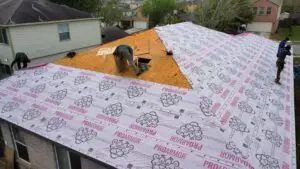
Step 6: Call a licensed San Antonio roofing contractor for emergency stabilization. Request same-day emergency tarping for any area of exposed deck or active water entry. Confirm the contractor’s Texas Department of Licensing and Regulation license number before authorizing work. In the post-storm San Antonio market, unlicensed storm chasers operate aggressively and can create claim complications that a licensed local contractor will not.
Step 7: Authorize emergency stabilization only, not permanent repair, at this stage. A tarp authorization or emergency patch approval does not commit the homeowner to using that contractor for the permanent repair. Keep the emergency stabilization and the permanent repair as separate decisions with separate contractor evaluations.
San Antonio Emergency Storm Response Timeline
| Time After Storm | Priority Action | Responsible Party |
|---|---|---|
| 0 to 30 minutes | Interior protection and content documentation | Homeowner |
| 30 to 60 minutes | Exterior photo documentation from ground level | Homeowner |
| 1 to 2 hours | Insurance company claim call | Homeowner |
| 2 to 4 hours | Licensed contractor emergency stabilization call | Homeowner |
| Same day to 24 hours | Emergency tarp or patch installation | Licensed contractor |
| 24 to 72 hours | Insurance adjuster inspection | Insurance company |
| 1 to 2 weeks | Permanent repair scope and estimate | Licensed contractor |
Common Emergency Storm Roof Repair Mistakes San Antonio Homeowners Make
Calling a contractor before calling the insurance company reverses the correct sequence and can create complications in the claim timeline. Insurers need to establish the claim independently before contractor involvement begins, and a claim that appears contractor-initiated rather than storm-triggered can receive additional scrutiny during the adjuster review. The insurance call takes ten minutes and should always precede the contractor call.
Signing a full repair contract or an Assignment of Benefits document during the emergency response period is the single most consequential legal mistake San Antonio storm victims make. Storm chaser contractors operating in the San Antonio market after major events apply significant pressure to secure a signed contract during the chaotic post-storm window before the homeowner has obtained competing bids or reviewed the claim settlement.
Texas law restricts Assignment of Benefits agreements in the insurance context for this reason. No document beyond a basic emergency tarping work order should be signed in the first 24 to 48 hours after a storm event. Skipping the interior documentation step because the exterior damage is the obvious priority eliminates the evidence that connects the roof damage directly to the interior loss.
An insurance adjuster who cannot see pre-repair photos of interior damage has no independent record of its scope and may limit the settlement to the roof repair alone, leaving the homeowner to fund interior restoration out of pocket. Attempting DIY emergency tarping on a storm-damaged San Antonio roof exposes homeowners to fall risk on a compromised surface at a moment when the structural integrity of the deck is unknown.
A roof that has sustained significant hail impact or wind loading may have deck damage that is not visible from the surface, and that creates a collapse risk for anyone walking on it without professional fall protection and structural assessment. The tarp installation cost is almost universally covered as a mitigation expense under standard Texas homeowners policies, making the DIY risk genuinely unnecessary.
Waiting for the insurance adjuster to arrive before installing emergency protection misunderstands both the homeowner’s obligation and the adjuster’s timeline. Texas homeowners’ insurance policies require the homeowner to take reasonable steps to mitigate further damage after a covered loss. Emergency tarping is a reasonable step, and it is expected to be completed before the adjuster inspection, not after.
San Antonio Storm Roof Repair Benchmarks by Roof Age
Roof age shapes both the severity of storm damage and the range of repair options available in the aftermath of a San Antonio weather event. Roofs 0 to 5 years old in San Antonio sustaining storm damage during this period are most likely dealing with either an installation defect that the storm exposed or an unusually severe event that exceeded the design threshold of even a well-installed roof.
Emergency repair in this age range should be accompanied by a warranty review if the roof was professionally installed within the standard workmanship warranty period. Between 5 and 10 years, San Antonio roofs are in a vulnerability window where UV degradation and thermal cycling have reduced sealant strip adhesion and shingle flexibility enough to make wind and hail damage meaningfully more likely than in the first years of service.
Emergency storm roof repair San Antonio. This range is typically straightforward but should be followed by a full professional assessment to identify whether the surrounding field has weakened to the point of requiring broader repair beyond the storm-damaged zone.
At 10 to 15 years, storm damage on San Antonio roofs in this age range frequently reveals cumulative prior damage that no single previous event was large enough to claim on independently. Emergency tarping and stabilization should be accompanied by a comprehensive damage documentation effort that captures the full condition of the roof rather than just the most visually obvious impact points.
Between 15 and 20 years, any significant storm damage to a San Antonio roof in this age range should trigger a replacement evaluation alongside the emergency stabilization. The surrounding field on a roof of this age is unlikely to deliver many additional years of reliable service, regardless of how well the storm damage is repaired, and a replacement decision made proactively produces a better financial outcome than a repair followed by replacement twelve months later.
Over the past 20 years, emergency stabilization after a San Antonio storm event has been a bridge to replacement, not a long-term repair strategy. Any licensed contractor who inspects a storm-damaged San Antonio roof of this age will recommend replacement as the permanent solution, and that recommendation reflects the reality that the underlying components of the roof system have reached the end of their serviceable life.
Technology Tools San Antonio Homeowners Can Use
Modern tools available to San Antonio homeowners make storm damage documentation, contractor verification, and claim management faster and more thorough than at any previous point. Hyperlocal weather radar apps with street-level storm tracking allow San Antonio homeowners to monitor storm cells in real time, confirm when a storm has fully passed before beginning exterior assessment, and record the exact time of storm passage at their address as supporting documentation for the claim filing date.
Hail verification services accept a San Antonio address and return a certified record of hail occurrence, including date, time, storm path, and maximum hail size at that specific location, providing independent third-party storm documentation that supports the claim, independent of the insurance adjuster’s own weather data. Drone inspection services deployable within 24 hours of a storm event in the San Antonio market provide high-resolution aerial imagery of the full roof surface from every angle, creating a timestamped visual damage record before any repair work begins that is both comprehensive and difficult for an adjuster to challenge.
The Texas Department of Licensing and Regulation online verification tool allows San Antonio homeowners to confirm any roofing contractor’s license status, insurance coverage, and complaint history from a smartphone in under two minutes, which is fast enough to complete before authorizing any post-storm emergency work.
Digital claims platforms offered by major Texas insurers allow San Antonio homeowners to open a claim, upload storm and damage photos, track adjuster scheduling, and receive settlement communications entirely through a smartphone app, eliminating the days of phone tag that previously delayed claim processing after major area-wide storm events.
DIY Response vs. Professional Emergency Repair: Know the Difference
San Antonio homeowners can and should handle the first-response interior protection steps, photo documentation from ground level, insurance company contact, and contractor scheduling without any professional assistance. These actions require no tools, no roofing knowledge, and no time on the roof surface, and completing them correctly in the first two hours produces measurably better claim outcomes than waiting for a professional to manage the process.
Every task that requires physical access to the roof surface after a storm, including tarp installation, panel or shingle resecurement, flashing emergency sealing, and debris removal from the deck, should be performed exclusively by a licensed San Antonio roofing contractor with active fall protection equipment. A storm-damaged San Antonio roof is an inherently unstable working surface.
Hail impact weakens the structural integrity of the deck at points that are not visible from above, wind loading stresses fastener connections throughout the structure, and wet roofing surfaces after a rain event reduce friction to a level where a slip is not recoverable without a safety harness. None of these risks are acceptable for an untrained homeowner when the emergency tarp cost is both modest and insurance-recoverable.
Seek immediate professional attention and do not enter the attic or upper floors if the roof structure shows visible sagging or deflection following a storm impact, if a tree or large structural element has made contact with the roof deck at any point, or if the storm was accompanied by a confirmed tornado or microburst wind event in the immediate area. These conditions require a licensed structural assessment before any person enters the spaces below the damaged roof section.
Final Thoughts
Emergency storm roof repair San Antonio is a process that rewards preparation, speed, and correct sequencing at every step. The homeowners who come through San Antonio storm seasons with manageable repair costs and fully funded insurance claims are the ones who knew who to call, in what order to call them, and what to document before anyone arrived.
That preparation costs nothing to develop before storm season and pays for itself completely the first time a storm makes it necessary. San Antonio’s weather is not getting less severe. The preparation window is always right now.
FAQs
1. How quickly do I need emergency storm roof repair in San Antonio?
A: Within 2 to 24 hours for any exposed deck or active leak. Every additional rain event through an unprotected breach adds thousands in preventable damage.
2. Does insurance cover emergency storm roof repair in San Antonio?
A: Yes. Emergency tarping and stabilization are standard covered mitigation expenses under Texas homeowners’ policies. Document everything before work begins.
3. What is the first thing to do after storm roof damage in San Antonio?
A: Protect the interior with plastic and buckets, photograph all damage immediately, call your insurer to open a claim, then contact a licensed contractor.
4: How do I tell a legitimate San Antonio contractor from a storm chaser?
A: Verify their Texas license at tdlr.texas.gov before signing anything. Local contractors have a physical address, reviews, and no pressure to sign immediately.
5: Should I let the emergency contractor also do the permanent repair?
A: Not automatically. Get at least two permanent repair bids. Emergency stabilization and permanent repair are separate decisions requiring separate evaluations.