
Metal carport repair is a task that most homeowners put off far longer than they should, typically because the damage starts small and the carport sits outside the main living space, where deterioration is easier to ignore. A bent panel, a loose bolt, or a small rust spot on a metal carport looks like a minor cosmetic issue until a windstorm peels a panel off the frame, a corroded post fails at the base, or sagging roof panels allow standing water to pour through onto a vehicle below.
Metal carports are one of the most cost-effective covered parking solutions available, but they require consistent attention to fasteners, panels, framing, and surface coatings to perform safely over their intended lifespan. This guide covers everything you need to know to assess, repair, and maintain a metal carport correctly.
What is Metal Carport Repair?
Metal carport repair is the process of restoring a damaged, deteriorated, or structurally compromised metal carport structure to a safe and fully functional condition by replacing panels, tightening or replacing fasteners, treating or replacing corroded components, straightening or reinforcing framing members, and resealing joints and penetrations to restore weather resistance.
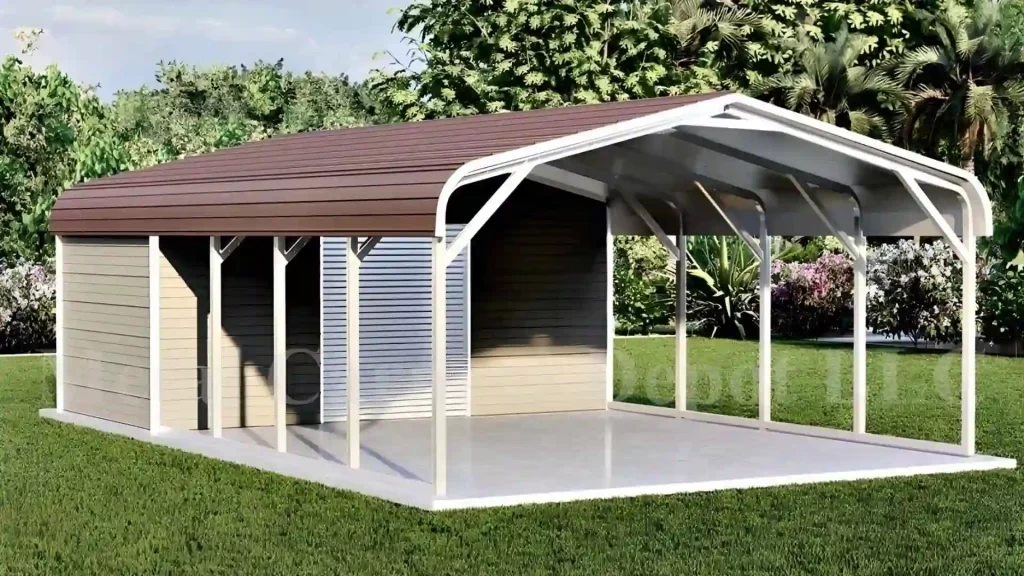
Metal carports are typically constructed from galvanized steel or aluminum framing with steel or aluminum roof and wall panels, connected by self-tapping screws, bolts, and purlins. Every connection point, panel edge, and surface coating is a potential failure point that degrades over time through wind loading, thermal cycling, moisture exposure, and UV radiation.
Metal Carport Components and Common Repair Needs
| Component | Material | Common Damage Type | Repair Approach |
|---|---|---|---|
| Roof panels | Galvanized steel or aluminum | Denting, rust, punctures, blow-off | Panel replacement or patch |
| Wall panels | Galvanized steel or aluminum | Rust, impact damage, warping | Panel replacement |
| Roof purlins | Steel C-channel or hat channel | Rust, bending, loose fasteners | Retighten, reinforce, or replace |
| Vertical posts | Steel tube or C-channel | Base corrosion, bending, loose anchors | Anchor repair, post sleeve, or replacement |
| Ridge cap | Steel or aluminum | Lifting, cracking, and sealant failure | Reseal or replace |
| Fasteners and screws | Galvanized or coated steel | Backing out, corrosion, and missing washers | Replace with matching grade fasteners |
| Anchor bolts | Steel with concrete embedment | Corrosion, loosening, and spalling of concrete | Re-anchor or epoxy injection |
Identifying exactly which component has failed before purchasing materials prevents the common mistake of replacing panels when the actual problem is a failing post anchor or a purlin that has lost its fastener engagement.
Why Carport Repair Matters (The Real Cost Breakdown)
The Cost of Ignoring Carport Damage
| Ignored Damage | Escalated Repair Cost | Consequence of Delay |
|---|---|---|
| Loose roof panel screws | $50 to $200 to retighten | Full panel blow-off in the next wind event, $400 to $900 to replace |
| Surface rust on posts | $100 to $300 to treat | Post base failure, $800 to $2,500 to replace and re-anchor |
| Bent roof panel | $200 to $500 to replace | Water pooling causes adjacent panel corrosion, $800 to $2,000 |
| Deteriorated ridge cap sealant | $50 to $150 to reseal | An active water leak damages stored vehicles or equipment |
| Loose post anchor bolts | $150 to $400 to re-anchor | Structural collapse in high wind, $3,000 to $8,000 to rebuild |
| Missing panel fasteners | $30 to $100 to replace | Wind uplift removes entire roof section, $2,000 to $6,000 |
Metal carport repair costs are almost always measured in hundreds of dollars when addressed at the right time and in thousands when the same problem is allowed to escalate through one or two additional storm seasons.
The Vehicle and Property Exposure
A collapsed or partially failed metal carport does not just require structure repair. It frequently damages the vehicles, equipment, or stored property beneath it at the same time. A single panel blow-off landing on a parked vehicle can cause $1,500 to $8,000 in auto body damage, depending on impact location and vehicle type. Addressing the structural integrity of a metal carport proactively protects not just the carport itself but every asset stored beneath it.
Types of Carport Damage: Know Your Repair First
Different metal carport damage types require different repair approaches, and diagnosing the specific failure before buying materials or calling a contractor prevents wasted spending on repairs that address symptoms rather than causes. Panel denting and puncture damage is the most visually obvious form of metal carport damage and commonly results from hail impact, falling branches, or contact with equipment or vehicles.
Small dents without through-punctures are primarily cosmetic on roof panels but can create water pooling zones if they distort the panel profile enough to interrupt drainage. Punctures and splits require patching or panel replacement to restore weather resistance.
Wind uplift damage occurs when roof panels are lifted and displaced by high winds, either partially separating from the purlin below or detaching completely. Wind uplift failures almost always begin at a fastener that has backed out, corroded, or been installed with an inadequate washer seal. Panels that have experienced one uplift event without full separation are weakened at every fastener point and should be re-secured with new fasteners across the full panel rather than just at the lifted edge.
Corrosion and rust damage progress differently depending on whether the carport is constructed from galvanized steel, painted steel, or aluminum. Galvanized steel rusts at cut edges, drilled holes, and scratched surfaces where the zinc coating has been compromised. Painted steel rusts beneath the coating when moisture reaches bare metal through scratches or chips. Aluminum does not rust but oxidizes, developing a chalky white surface that weakens the material over time if left untreated.
Post base failure is one of the most structurally serious metal carport repair scenarios and develops when the vertical support posts corrode at or below the concrete anchor point, when anchor bolts loosen from concrete spalling or inadequate embedment depth, or when the post itself is bent from vehicle or equipment impact. A carport with compromised post bases is a structural collapse risk under wind loading and should be assessed and repaired before any additional storm season.
Fastener failure involves the self-tapping screws and bolts that connect panels to purlins and purlins to frames, backing out from thermal cycling, vibrating loose from wind-induced panel movement, or corroding to the point where their clamping force is lost. Fastener failures are the most preventable form of metal carport damage and the easiest to address during annual maintenance.
Carport Repair: Step-by-Step Process
A properly sequenced metal carport repair addresses structural components before surface components, working from the foundation upward.
Step 1: Perform a full structural assessment before any surface repairs. Check every post anchor at the base for corrosion, looseness, or concrete spalling. Confirm that each post is plumb and undamaged. Assess every purlin connection to the frame for fastener engagement and rust. Surface repairs on a structurally compromised carport are wasted effort until the frame is confirmed sound.
Step 2: Re-anchor or replace any compromised post bases. Posts with corroded bases that have not yet failed structurally can often be repaired using a post sleeve, a steel tube slipped over the corroded section and anchored to new concrete, rather than full post replacement. Posts that are bent, cracked, or separated from the anchor require full replacement before any other repair work proceeds.
Step 3: Retighten or replace all loose and missing fasteners. Work systematically across every roof panel and wall panel, checking each fastener for engagement, corrosion, and washer condition. Replace any screw that spins without biting, shows visible corrosion at the head, or has a cracked or missing neoprene washer seal. Use replacement fasteners that match the original diameter, length, and coating to maintain load rating.
Step 4: Replace damaged or corroded panels. Remove panels that are punctured, severely bent, or rusted through by backing out all fasteners along the panel edges, lifting the panel clear of the purlin, and installing the replacement panel in the same orientation with new fasteners at every purlin contact point. Order replacement panels in the same profile and gauge as the existing panels to ensure proper lap and fastener alignment.
Step 5: Treat surface rust on intact panels and framing. Wire brush or sand all rust back to clean metal, apply a rust converter product to neutralize remaining oxidation, prime with a zinc-based metal primer, and top coat with a metal roof paint rated for exterior exposure. This sequence stops active corrosion and restores the surface coating that prevents recurrence.
Step 6: Reseal the ridge cap and all panel laps. Apply a butyl or polyurethane sealant rated for metal roofing applications to the full length of the ridge cap seam, all panel-to-panel lap joints, and any penetration point where fasteners have created gaps in the panel surface. Reseal all existing caulk joints that show cracking or separation.
Step 7: Confirm drainage and clear all debris. Ensure that the roof panel profile is directing water to the correct drainage edge and that no debris accumulation is creating ponding zones on the roof surface. Debris left on a metal carport roof accelerates panel corrosion at contact points and adds weight that increases fastener stress.
Carport Repair Cost Reference
| Repair Type | DIY Material Cost | Professional Total Cost | Time Required |
|---|---|---|---|
| Fastener replacement (full carport) | $30 to $100 | $150 to $400 | 2 to 4 hours |
| Single panel replacement | $80 to $200 | $300 to $700 | 2 to 4 hours |
| Post base re-anchoring (per post) | $50 to $150 | $250 to $600 | 2 to 3 hours |
| Full rust treatment and recoating | $100 to $300 | $400 to $1,200 | 4 to 8 hours |
| Ridge cap reseal | $20 to $60 | $150 to $350 | 1 to 2 hours |
| Full panel replacement (entire roof) | $400 to $1,000 | $1,500 to $4,000 | 1 to 2 days |
Common Carport Repair Mistakes to Avoid
Replacing damaged panels without inspecting the purlins and fasteners beneath them produces a new panel on a failing substrate that will experience the same damage within one to two seasons. A panel that has blown off or corroded through in a specific location has almost always done so because the fasteners at that location failed first. Replacing the panel without addressing the fastener and purlin condition underneath it repeats the failure cycle rather than ending it.
Using the wrong fastener type when replacing screws is a mistake that compromises the repair from the moment it is completed. Metal carport panels require self-tapping screws with neoprene washer heads that create a weather seal at the panel surface. Substituting standard wood screws, drywall screws, or uncoated fasteners introduces corrosion at every repair point and fails to create the weather seal that prevents water entry at each fastener hole.
Painting over active rust without treating it first is a surface repair that locks moisture against bare metal beneath the paint film and accelerates corrosion rather than stopping it. The paint may look clean for one season before bubbling, peeling, and revealing rust that is now worse than it was before the paint was applied.
Ignoring the post anchor condition because the posts appear straight and stable is a structural assessment failure that leaves the most safety-critical component of the carport uninspected. Post anchors corrode from the inside of the concrete embedment zone outward, meaning a post that looks stable at the surface may have lost the majority of its anchor engagement below grade.
Probing anchor bolts with a wrench and checking the concrete around each base for cracking or spalling takes five minutes per post and reveals anchor failures before they become collapse events. Attempting to straighten a significantly bent structural post rather than replacing it introduces residual stress into the metal that reduces its load capacity below the original rating, creating a post that looks repaired but performs below the structural requirement of the carport design.
Metal Carport Performance Benchmarks by Age
Understanding how metal carports age in real conditions sets realistic expectations for maintenance intervals and repair frequency. Carports 0 to 5 years old that develop problems are most commonly experiencing installation defects, including inadequate post anchor depth, fasteners installed without proper washer seals, and panels lapped in the wrong direction relative to the prevailing weather exposure. These are workmanship issues that should be addressed under the installer’s warranty if the carport was professionally installed.
Between 5 and 10 years, the galvanized coating on steel panels and framing begins to thin at cut edges and fastener penetrations, and surface rust begins to appear at these points in high-humidity or coastal environments. Performing a localized metal carport repair or spot treatment of rust at this stage prevents the progression to through-corrosion that would otherwise require full panel or post replacement.
At 10 to 15 years, fastener corrosion and backing-out from thermal cycling become the primary maintenance concern. A full fastener inspection and retightening or replacement across the entire system at the 10-year mark is one of the highest-value maintenance actions available for extending the service life of a metal carport
Between 15 and 20 years, galvanized steel carports in outdoor environments commonly show significant rust progression at post bases, purlin connections, and panel laps. Full rust treatment and recoating of the frame and panels at this stage can extend the carport’s useful life by another 10 to 15 years at a fraction of full replacement cost.
In the past 20 years, metal carports should receive a structural engineering assessment if any significant storm damage, post-base corrosion, or frame bending is present. A structure in this age range with multiple compromised components may be more economically replaced than repaired, particularly if the replacement can be sized and configured to better meet the homeowner’s current parking and storage needs.
Technology Tools Homeowners Can Use
Modern tools make metal carport inspection and repair more accurate and more safely completed than traditional ladder-and-visual-inspection methods. Corrosion detection meters measure the remaining galvanized coating thickness on steel panels and framing without damaging the surface, allowing homeowners to identify areas where the corrosion protection has thinned below the minimum effective level before visible rust appears.
Torque screwdrivers and impact drivers with torque-limiting settings ensure that replacement fasteners are installed to the correct clamping force without over-driving, which strips the self-tapping thread and eliminates the fastener’s load capacity.
Moisture meters confirm whether water is infiltrating the concrete at post anchor bases, indicating active corrosion of the embedded steel even when the visible post surface appears intact. Metal roof sealant tape products with embedded aluminum facing provide a faster and more durable ridge cap and panel lap repair than liquid sealants in applications where the joint gap is too large for a standard caulk bead to bridge reliably.
Structural load calculators available through metal building manufacturers allow homeowners to input their carport dimensions and local wind and snow load requirements to confirm whether the existing structure meets the design standard for their location, which is particularly useful before deciding between repair and replacement on an older or damaged system.
DIY Repair vs. Professional Repair: Know the Difference
Homeowners with basic mechanical skills and comfort working at low roof heights can safely handle fastener inspection and replacement, ridge cap and panel lap resealing, surface rust treatment and recoating on panels and framing within reach from ground level or a stable step ladder, and minor panel dent assessment. These tasks use widely available materials, require no specialized equipment beyond a drill and caulk gun, and deliver meaningful protection against further deterioration when completed correctly.
However, full panel replacement on roof sections, post base assessment and re-anchoring, structural post replacement, any repair work requiring access to the roof peak of a tall carport, and any repair following a partial structural collapse or significant wind damage event should be performed by a licensed contractor with metal building repair experience. Metal carport roof panels are lightweight individually but awkward to handle at height, and working on a compromised structure before its integrity has been confirmed by a professional creates a fall and collapse risk that is not justified by the cost of professional repair.
Seek immediate professional attention if any vertical post is visibly leaning, bent, or separated from its anchor base, if the roof structure shows visible sagging or deflection between support points, or if a significant wind event has displaced one or more roof panels and the remaining panels are showing movement at their fastener points. These conditions indicate that the carport is at risk of progressive collapse under additional load and should not be accessed until a structural assessment has been completed.
Final Thoughts
Metal carport repair is one of the most straightforward and highest-return maintenance investments a homeowner can make because the cost of each repair tier is dramatically lower than the next tier of damage it prevents. Tightening fasteners costs almost nothing and prevents panel blow-off.
Treating rust costs a few hundred dollars and prevents post failure. Replacing a post costs far less than rebuilding a collapsed carport and replacing the vehicle it lands on. The maintenance sequence is simple, the intervals are predictable, and the financial logic of early action over delayed response is as clear in carport repair as it is anywhere in home maintenance.
FAQs
1. What is the most common metal carport repair needed?
A: Fastener replacement and retightening. Screws back out from thermal cycling and wind vibration, leading to panel loosening and eventual blow-off.
2. How much does metal carport repair typically cost?
A: Minor repairs like fastener replacement and resealing run $50 to $400. Full panel replacement or post re-anchoring costs $300 to $2,500, depending on scope.
3. Can I repair a metal carport myself?
A: Yes for fastener replacement, rust treatment, and resealing. Post-base repairs and full panel replacement on tall structures require a licensed contractor.
4: How do I stop rust on a metal carport?
A: Sand rust back to clean metal, apply a rust converter, prime with zinc-based primer, and finish with exterior metal roof paint. Never paint over active rust.
5: When should I replace a metal carport instead of repairing it?
A: Replace when post bases are structurally compromised, multiple panels are corroded through, or the frame is bent beyond straightening. Past 20 years, assess replacement seriously.